
Burr-Free Copper Strip for Transformer Windings
2026-10-14
Among the various causes of failure in transformer windings, insulation breakdown and partial discharge triggered by edge burrs account for a significant proportion of incidents. While the burrs on standard slit copper strips are often invisible to the naked eye, they progressively amplify risks during the winding process and under electric field stress, ultimately compromising the equipment's long-term operational stability. As a specialized exporter of transformer copper strips, Haomei Aluminum offers burr-free copper strips designed specifically for windings, utilize a high-precision edge-trimming process to completely eliminate burrs and sharp corners, thereby ensuring electrical safety and high manufacturing yields at the material level.
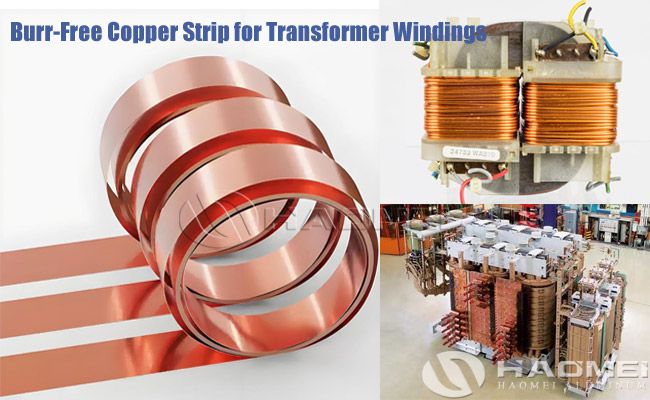
Eliminating burrs is a crucial measure for suppressing partial discharge in windings. According to the principles of electrostatic field distribution, electric field intensity on a conductor's surface is inversely proportional to the radius of curvature; the burrs on standard slit copper strips can have a curvature radius in the micrometer range, causing local electric field intensity to reach three to five times that of the strip's flat surface. When rated voltage is applied, the electric field strength at these sharp tips reaches the insulation breakdown threshold first, triggering continuous partial discharge. This gradually erodes the insulation material, forming "electrical tree" channels that eventually lead to inter-turn insulation failure. After undergoing specialized shaving and trimming processes, the burr-free transformer copper strips feature smooth edges without protruding tips, ensuring a uniform electric field distribution along the edge. This raises the partial discharge inception voltage by over 30% and effectively expands the insulation design margin—a benefit particularly pronounced in dry-type transformers rated at 10kV and above.
The burr-free characteristic significantly improves winding manufacturing yields and reduces latent quality risks. On high-speed foil winding lines, where strip tension can reach tens of newtons, hard edge burrs can scratch the surface of the insulation paper, creating micro-defects that are difficult to detect visually. While such defects often pass routine factory inspections, they can gradually manifest as insulation failures within one to two years of operation. Furthermore, burrs cause continuous abrasion against the equipment's guide rollers and molds, accelerating component wear. Based on years of industry experience, many clients previously struggled with winding partial discharge (PD) test pass rates falling below 80% due to burrs on standard copper strips; however, after switching to burr-free transformer copper strips, the first-pass winding yield rose to over 95%, significantly reducing rework and scrap costs.
Haomei Aluminum's burr-free copper strips utilize C11000 electrolytic tough-pitch copper as the base material, featuring a combined copper and silver content of at least 99.90%, an oxygen content controlled below 0.02%, and stable electrical conductivity of 100%–101% IACS. The products undergo bright annealing in a protective atmosphere to achieve an "O-temper", with Vickers hardness controlled between HV55 and HV65 and elongation at break ≥35%, ensuring excellent fit during winding and forming. Available in thicknesses ranging from 0.1 mm to 3.0 mm, the strips can be slit to custom widths based on winding designs; they feature thickness tolerances within ±0.005 mm and edge straightness ≤1 mm/m, making them fully compatible with high-speed, automated foil winding production lines.
The burr-free copper strip comply with international standards such as ASTM B152 and are supplied with comprehensive material certification and edge inspection reports. We offer options for large coil weights and vacuum-sealed, moisture-proof packaging, with edge processing precision tailored to specific voltage class requirements. Please contact Haomei for detailed specifications, pricing, and a customized supply solution.