
Comparison Between Aluminum And Copper Foil In Transformer
2026-07-09
In the design and manufacturing of foil-wound transformers, the selection of the conductive substrate directly affects the equipment's energy efficiency, size, weight, manufacturing cost, and long-term operational reliability. Copper foil and aluminum foil are currently the two most widely used winding materials in the industry. They differ significantly in conductivity, physical properties, processing technology, and overall cost, making them suitable for transformer products of different voltage levels, capacities, and application scenarios.
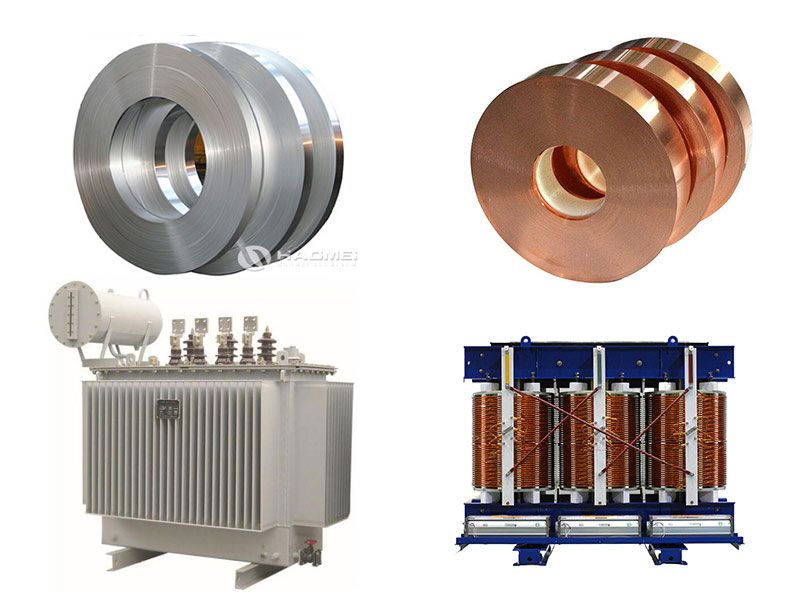
The core performance parameters are compared below:
Performance Dimension | C11000 Copper Foil (Soft Annealed) | 1060 Electrical Aluminum Foil (O State) |
Conductivity | ~100% IACS | ~61% IACS |
Density | 8.9 g/cm³ | 2.7 g/cm³ |
Thermal Conductivity | ~401 W/(m·K) | ~237 W/(m·K) |
Elongation | ≥35% | ≥25% |
Material Cost | Higher, large price fluctuations | Lower, relatively stable price |
From a conductivity perspective, copper foil's intrinsic conductivity is significantly better than that of aluminum foil. The resistivity of copper foil is approximately 0.0172 Ω·mm²/m, while that of aluminum foil is approximately 0.0283 Ω·mm²/m. To maintain the same DC loss under the same current-carrying capacity requirements, the cross-sectional area of aluminum foil needs to be about 1.6 times that of copper foil, resulting in a corresponding increase in winding volume. For large-capacity transformers with high load losses and stringent energy efficiency requirements, copper foil has an irreplaceable advantage in reducing Joule heat loss and improving energy efficiency.
In terms of weight and economy, aluminum foil has a significant advantage. Aluminum's density is only about 30% of copper's. Even with an increased cross-sectional area to compensate for the difference in conductivity, the total weight of aluminum windings is still only about 50% of that of copper windings for the same current-carrying capacity. This significantly reduces the overall weight of the transformer, alleviating structural load and transportation and installation costs. Furthermore, aluminum prices have consistently been lower than copper prices in the raw material market. Using aluminum foil windings effectively controls material costs, enhances the market competitiveness of low- to mid-range distribution transformers, and is highly attractive to cost-sensitive projects.
Both have their own characteristics in terms of mechanical properties and processing characteristics. Copper foil offers better ductility, achieving an elongation of over 35% in a soft-annealed state. It exhibits high bending fit during winding, excellent fatigue resistance, and is suitable for complex winding structures and high-frequency vibration conditions. Furthermore, copper has stable welding performance, low joint resistance, and higher joint reliability under high-current conditions. Aluminum foil is softer, but its surface easily forms a dense oxide film, making welding more difficult and requiring specialized processes such as ultrasonic welding and inert gas shielded welding. This necessitates stricter joint process control. Additionally, aluminum foil has a higher coefficient of thermal expansion than copper foil, resulting in greater deformation stress under temperature cycling. The winding structure design must fully consider the impact of thermal expansion and contraction.
Regarding heat dissipation and temperature rise, copper has a higher thermal conductivity, leading to higher heat transfer efficiency and lower hotspot temperatures within copper foil windings, which helps extend the life of insulation materials. However, aluminum foil windings have a larger cross-sectional area, resulting in a correspondingly larger overall heat dissipation surface area. With proper design, temperature rise control can also meet standard requirements. The actual temperature difference between the two needs to be comprehensively evaluated based on the specific winding structure and cooling method.
The differentiation in applicable scenarios is the core reason for their long-term coexistence. Copper foil is more suitable for large-capacity, high-voltage, and high-efficiency power transformers, as well as special transformers for photovoltaic, wind power, and rail transportation, where reliability and size constraints are high. Aluminum foil, on the other hand, is widely used in small and medium-sized distribution transformers, dry-type transformers, and prefabricated substations, offering significant cost-effectiveness advantages in civil buildings and conventional power distribution networks. Actual selection requires a comprehensive consideration of energy efficiency standards, cost budgets, weight limitations, and operation and maintenance requirements. There is no absolute superiority or inferiority; the key is to match the core needs of the specific application scenario.