
1050 VS 1060 Aluminum Strips For Transformer Winding
2026-08-06
In the transformer aluminum winding material system, 1050 and 1060 aluminum strips both belong to the 1000 series industrial pure aluminum and are the two grades most frequently compared in foil winding processes. Their nominal purity differs by only 0.1 percentage points, often leading buyers to consider them interchangeable materials. However, from a professional perspective of transformer design and manufacturing, differences in impurity element control, conductivity, process adaptability, and cost positioning determine their respective applicable boundaries.
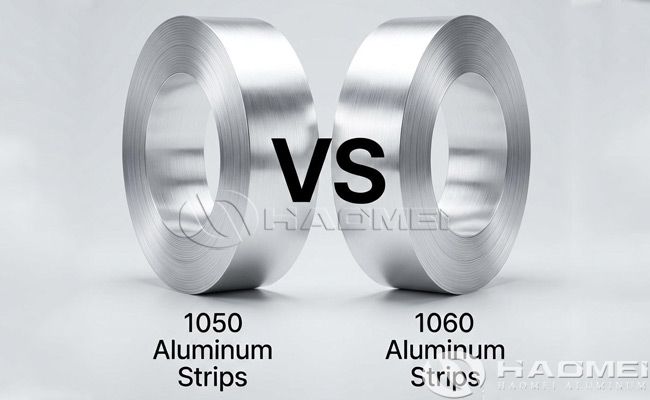
From the fundamental differences in chemical composition, the core distinction between the 1050 and 1060 aluminum grades lies in aluminum purity and the upper limit of iron and silicon impurities. According to ASTM standards, 1050 aluminum strip has an aluminum content of no less than 99.5%, an iron limit of 0.40%, and a silicon limit of 0.25%; 1060 aluminum strip has an aluminum content of no less than 99.6%, a reduced iron limit of 0.35%, and silicon remains unchanged at 0.25%. A seemingly minor difference of 0.05% in iron content directly affects the lattice integrity and electron scattering of the material, thus impacting its conductivity. In the annealed soft state, 1060 aluminum strip maintains a stable conductivity above 61% IACS, with batches achieving near 62% IACS in high-quality batches. In contrast, 1050 aluminum strip typically fluctuates between 59% and 61% IACS, with conductivity declining further as impurity content approaches the upper limit. For transformer windings, every 1% increase in conductivity corresponds to approximately a 1.6% decrease in DC resistance, and this difference in load loss accumulates over long-term operation.
The two also exhibit divergent characteristics in terms of mechanical properties and winding process compatibility. Due to its slightly higher impurity content, 1050 aluminum strip exhibits slightly better tensile strength and hardness after annealing, and slightly stronger resistance to deformation, making it suitable for thicker strip winding applications with higher tension. However, its elongation is slightly lower than 1060 aluminum strip, resulting in less forming margin under extreme bending conditions. 1060 aluminum strip has higher purity and more uniform grain structure. In its soft-annealed state, it can achieve an elongation of over 30%, resulting in superior bending and bonding performance, less springback during winding, and higher inter-turn bonding. This effectively reduces the risk of partial discharge in the winding, making it particularly suitable for high-precision thin-foil winding processes. For products requiring high winding density, such as dry-type transformers, 1060 aluminum strip exhibits superior process tolerance and finished product consistency.
In terms of corrosion resistance and long-term operational stability, 1060 aluminum strip also has a slight advantage. Higher purity means fewer grain boundary impurities, resulting in lower electrochemical corrosion tendency in humid, hot, and salt spray environments, and a more uniform and dense surface oxide film. For exposed environments such as outdoor transformer substations and distribution transformers in coastal areas, 1060 aluminum transformer windings offer higher long-term reliability redundancy; however, in controlled environments such as indoor dry-type transformers and constant-temperature machine rooms, the lifespan difference between the two is not significant.
Price is the most direct dividing line between the two. In the current export market, the FOB price of soft-annealed aluminum strip meeting transformer-grade quality is generally above $4,000/ton. Above this benchmark, there is a clear price gradient between 1050 and 1060 grades. 1050 aluminum strip, due to slightly lower smelting quality control thresholds and a wider range of raw material compatibility, is typically priced between $4,000 and $4,200/ton, focusing on high cost-effectiveness. 1060 aluminum strip, due to higher purity requirements and lower yield rates in casting and cold rolling processes, is typically priced between $4,200 and $4,500/ton, corresponding to higher conductivity and quality consistency. If customized requirements such as precision slitting, edge grinding, and vacuum packaging are added, the prices of both grades will increase accordingly.
The actual selection needs to be based on a comprehensive judgment of the transformer's energy efficiency rating, capacity, and cost positioning.
For cost-sensitive projects such as ordinary distribution transformers and residential substations, 1050 aluminum strip is sufficient to meet design requirements, offering a clear cost-effectiveness advantage.
For transformers with high energy efficiency requirements, large capacities, or harsh operating environments, the performance redundancy of 1060 offers greater long-term value.
Haomei Aluminum can supply two grades of aluminum strip for transformer, both employing protective atmosphere bright annealing and precision trimming processes. Performance indicators are stable and controllable. We can provide targeted material selection advice and customized slitting services based on customer design requirements.
In general, 1050 and 1060 aluminum strips for transformer winding are not a matter of high-end versus low-end, but rather sub-categories within the pure aluminum series targeting different performance weights. Understanding the performance transmission path behind a 0.1% purity difference is crucial for making the most suitable procurement decisions for project needs.