
Copper Strip/Foil For Dry Type Transformers
2026-07-23
With increasing fire safety requirements in urban power distribution networks, data centers, rail transit, and commercial buildings, dry type transformers are widely used due to their oil-free, flame-retardant, and maintenance-free characteristics. Unlike oil immersed transformers, which rely on insulating oil to simultaneously perform insulation and heat dissipation, dry type transformers use air or epoxy resin as the insulating medium, operating in a more demanding environment. This places higher demands on the surface quality, performance uniformity, and high-temperature stability of the winding conductive substrate. Copper foil for dry type transformers is a core conductive material optimized for these operating conditions, directly affecting the partial discharge level, temperature rise control, and long-term service life of the entire unit.
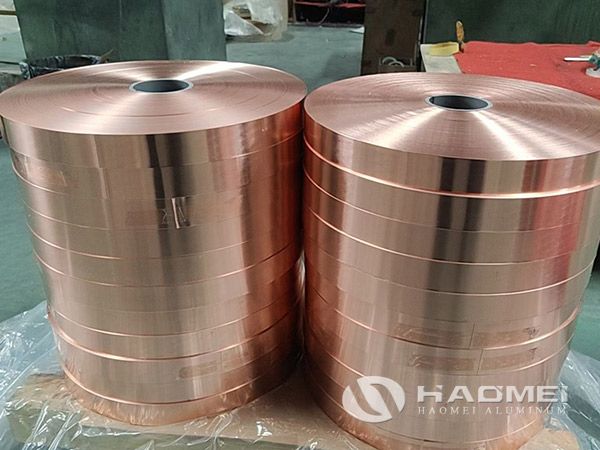
Dry type transformer copper strip generally uses C11000 electrolytic tough copper, with some high-grade products offering oxygen-free copper grades. For the long-term operating temperature requirements of dry type transformers (F-class (155℃) and H-class (180℃), the oxygen content and impurity element ratio of the copper material must be strictly controlled to avoid grain boundary oxidation and embrittlement at high temperatures. Haomei Aluminum's dry type transformer copper strips have a total copper-silver content of no less than 99.90%, with oxygen content consistently controlled below 0.02%. They exhibit strong structural stability under high-temperature conditions, eliminating the risk of hydrogen embrittlement. Conductivity remains within the 100%~101% IACS range, ensuring low-loss characteristics of the windings even under full-load, high-temperature operation, effectively reducing load temperature rise.
The uniformity of the soft annealing process is a core quality control point for dry type transformer copper foil. Dry type transformer foil windings have multiple layers and high winding tension. If the copper foil's hardness is uneven across its entire width, residual stress and poor inter-turn adhesion can easily occur after winding, leading to excessive partial discharge. This series of copper foils uses continuous protective atmosphere bright annealing to achieve complete recrystallization. The finished product has a stable Vickers hardness of HV55~HV65, with a hardness deviation in the width direction not exceeding HV5, and an elongation at break ≥35%. Uniform soft-state properties ensure that the copper foil adheres tightly to the skeleton on a high-speed foil winding machine, with no gaps or springback between turns. This results in uniform stress distribution after winding, reducing the risk of partial discharge at the substrate level.
Surface and edge quality control is particularly critical for dry type transformers. In oil immersed transformers, insulating oil can fill minor defects and suppress tip discharge. However, dry-type transformers rely on insulating films or resin casting for interlayer insulation. Minor scratches, burrs, and sharp edges on the copper foil surface can directly cause electric field distortion, triggering partial discharge and potentially leading to insulation breakdown over time. The copper foil used in dry-type transformers undergoes a specialized rounded edge grinding process to remove burrs and sharp edges, ensuring controllable edge roughness. After cleaning, the surface is free of residual oil, oxide spots, and roller marks, resulting in a uniform surface condition. This improves adhesion to the insulating material and ensures bonding strength during epoxy resin casting, preventing delamination and bubble defects.
In terms of dimensional accuracy, the copper foil thickness for dry-type transformers ranges from 0.1mm to 2.0mm, with customizable slitting widths based on capacity. Thickness tolerance is controlled within ±0.005mm, and side curvature is ≤1mm/m, adapting to the continuous feeding requirements of fully automated foil winding production lines and reducing misalignment and lamination deviations. The product supports large-coil supply, reducing the number of intermediate winding joints, lowering joint resistance and welding defect risks, and further improving the overall reliability of dry-type transformer windings.
With the continuous expansion of new energy grid connection and data center construction, dry-type transformers are upgrading towards larger capacity, lower partial discharge, and higher reliability, leading to increasingly stringent quality requirements for copper foil substrates. Specifically optimized copper foil for dry-type transformers, through comprehensive process adaptation in material selection, annealing, and surface treatment, provides stable material support for the efficient and safe manufacturing of dry-type transformers.