
Why Are Soft Copper Strip Used for Transformer Windings?
2026-09-03
In the selection of copper strip for transformer windings, conductivity, thickness, and purity are usually considered core indicators, while the material's hardness/softness temper (annealed temper) is often relegated to a secondary parameter. In fact, cold-rolled hard copper strip cannot be directly used in winding manufacturing. Soft annealing is an essential core process for transformer copper strips. By altering the internal lattice structure of the metal, soft copper strip for transformer winding comprehensively affects winding quality from forming process and long-term reliability to electrical performance, forming the fundamental basis for ensuring stable transformer operation.
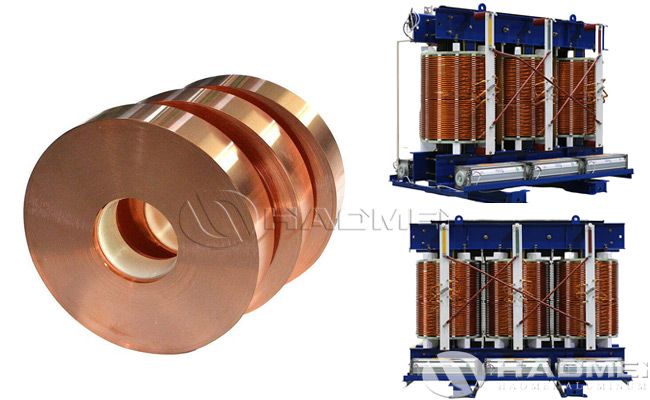
From the perspective of winding forming process, a soft temper is a basic prerequisite for foil winding. Cold-rolled hard copper strip (H-state) suffers from severe internal lattice distortion due to work hardening, with a Vickers hardness typically above HV100, an elongation at break of less than 10%, and is brittle and exhibits significant springback. When using hard copper strip for winding, microcracks easily appear at bends, and the strip's springback causes excessive inter-turn gaps, resulting in a low winding fill factor and excessive overall volume. In contrast, soft copper strip (O- temper) that has undergone full recrystallization annealing has a stable hardness reduced to HV55~HV65, an elongation at break ≥35%, and a flexible and uniform material. During winding, it can closely conform to the curved surface of the winding skeleton, with near-zero springback and no significant inter-turn gaps, increasing the winding fill factor by more than 5%. Based on my years of experience, many manufacturers choose semi-hard copper strip to reduce costs, resulting in loose windings with low partial discharge test pass rates. The rework and scrap costs far exceed the price difference of the annealing process.
Eliminating residual stress is the core value of soft copper strip in ensuring long-term reliability. Hardened copper strips retain significant residual cold-rolling stress, which further accumulates after winding. During long-term temperature cycling in transformer operation, fatigue cracks gradually develop at stress concentration points, ultimately leading to winding fracture, inter-turn displacement, and other faults. This risk is particularly pronounced in new energy transformers with frequent load fluctuations. Soft annealing, through precise temperature control, allows for complete recrystallization within the copper strip, breaking up distorted crystal lattices and regenerating uniform equiaxed grains, completely eliminating residual stress. Soft temper transformer copper strip windings exhibit uniform deformation under alternating temperature conditions, preventing localized stress accumulation and increasing fatigue life several times over, thus reducing long-term transformer maintenance risks from a material perspective.
In terms of electrical performance, soft annealing also brings significant improvements. Cold rolling hardening reduces the conductivity of copper strips by 2%–3% IACS and causes uneven performance distribution along the width direction, resulting in unbalanced winding losses and locally higher temperature rises. The conductivity of the soft copper strip recovers to 100%~101% IACS, with a full-width performance deviation of less than 0.5% IACS. The winding DC resistance is uniform and stable, and load losses are controllable. Simultaneously, the tight inter-turn bonding reduces interlayer air gaps, effectively suppressing partial discharge. Combined with the insulating medium, this further enhances the insulation margin of the winding.
Haomei Aluminum's soft copper strip for transformer winding employs a protective atmosphere bright annealing process, resulting in uniform performance across the entire roll. Combined with precision rounded edges, it can be directly adapted to high-speed foil winding production lines. Ultimately, soft copper strip is not simply about "softening the material," but rather about achieving a comprehensive upgrade in processability, reliability, and electrical performance through metal structure reconstruction, it is a core indicator that cannot be compromised in transformer winding quality control.