
Why is Aluminum Foil Used in Transformer Windings
2026-07-30
In the selection of winding materials for power transformers, copper is often considered the optimal solution for conductivity. However, in the global distribution transformer, dry-type transformer, and prefabricated substation sectors, aluminum foil windings have long held a significant market share. The widespread application of aluminum foil in transformer winding is not simply a cost compromise, but a comprehensive engineering decision based on material properties, process adaptability, life-cycle value, and scenario requirements. Its unique technical and economic advantages make it irreplaceable in specific application scenarios.
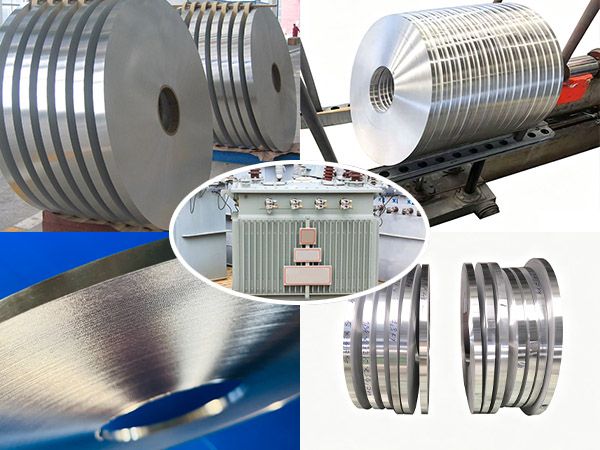
From a supply chain and cost control perspective, the natural endowment of aluminum resources determines its stable supply attribute among bulk industrial materials. The reserves of aluminum in the Earth's crust are far higher than those of copper, the global aluminum industry chain has ample capacity, and the price fluctuation of raw materials is significantly less than that of copper. For the distribution transformer industry, with its huge annual demand, using aluminum foil windings can effectively avoid the cost risks brought about by drastic fluctuations in commodity prices and ensure the budget stability of mass production projects. Meanwhile, the price per unit weight of aluminum is significantly lower than that of copper. Even with an increase in cross-sectional area to compensate for the difference in conductivity, the winding material cost of a single transformer can still be reduced by more than 20%. This advantage is particularly evident when production capacity is scaled up, effectively reducing the cost of terminal equipment and improving the input-output ratio of power distribution network construction.
Lightweighting is another core engineering value of aluminum foil windings. Aluminum's density is only about 30% of copper's. Under the same current-carrying design, the total weight of aluminum foil windings is about 50% of that of copper windings. For dry-type transformers, pole-mounted transformers, and mobile prefabricated substations installed inside buildings, the reduction in overall weight not only reduces transportation and hoisting costs but also significantly reduces the load on the building structure, simplifying the design of the installation foundation. Especially in scenarios such as urban commercial buildings and data center substations, lightweight aluminum-winding dry-type transformers can better adapt to floor installation space and load-bearing limitations, expanding the boundaries of the equipment's applicable scenarios.
Aluminum foil also has unique advantages in terms of foil winding process adaptability. Annealed soft aluminum foil exhibits a uniform and flexible texture, excellent bending performance, and a tight fit to the winding frame with high inter-turn conformity. Combined with the large heat dissipation surface area of the wide aluminum foil, the overall heat dissipation effect of the winding is excellent, particularly in air-cooled dry-type transformers. Although transformer aluminum foil welding requires specialized processes, mature ultrasonic welding technology has completely solved the joint reliability problem, and the foil winding itself has fewer joints, resulting in a controllable overall failure rate. Furthermore, the naturally formed dense oxide film on the aluminum surface provides excellent resistance to atmospheric corrosion, exhibiting excellent surface stability under long-term operation in the open environment of dry-type transformers, and is not prone to rust and deterioration.
From an energy efficiency design perspective, aluminum foil windings are not synonymous with low energy efficiency. Through reasonable optimization of the winding cross-sectional area and structural design, aluminum winding transformers can fully meet the requirements of current energy efficiency standards at all levels. For distribution transformers in power distribution networks with a large number of low load rates, no-load losses dominate energy consumption, while the impact of load losses is relatively limited. In this case, the cost and weight advantages of the aluminum foil solution far outweigh the slight increase in load losses, resulting in a higher overall cost-effectiveness.
Haomei Aluminum's 1060 transformer aluminum foil undergoes precise bright annealing, resulting in uniform and stable performance. Its burr-free edges are ground, allowing for direct compatibility with high-speed foil winding production lines, providing reliable aluminum winding material solutions for transformer customers worldwide.
In general, the selection of aluminum foil for transformer windings is a rational choice resulting from a combination of technological, cost, and application scenarios. It is not a cheap substitute for copper, but rather an optimized solution for specific applications, continuing to play an irreplaceable role in power distribution and dry-type transformers.