
Aluminum Grades For Cable Armouring?
2026-05-28
As the core mechanical protective structure of cable systems, the material properties of armor directly determine the cable's impact resistance, corrosion resistance, and fatigue resistance, which are crucial for ensuring the long-term stable operation of power, communication, and industrial control cables. 5xxx series aluminum-magnesium alloys, with their comprehensive advantages of being non-magnetic, lightweight, high-strength, easy to process, and rust-resistant, have replaced traditional steel as the mainstream material for high-end cable armor. Haomei Aluminum focuses on the R&D and production of aluminum materials for cable systems. For the three mainstream aluminum grades for cable armouring —5052, 5154, and 5154A—we provide a professional breakdown from the perspectives of composition, mechanical properties, process compatibility, and application scenarios, offering technical references for cable manufacturers to accurately select materials.
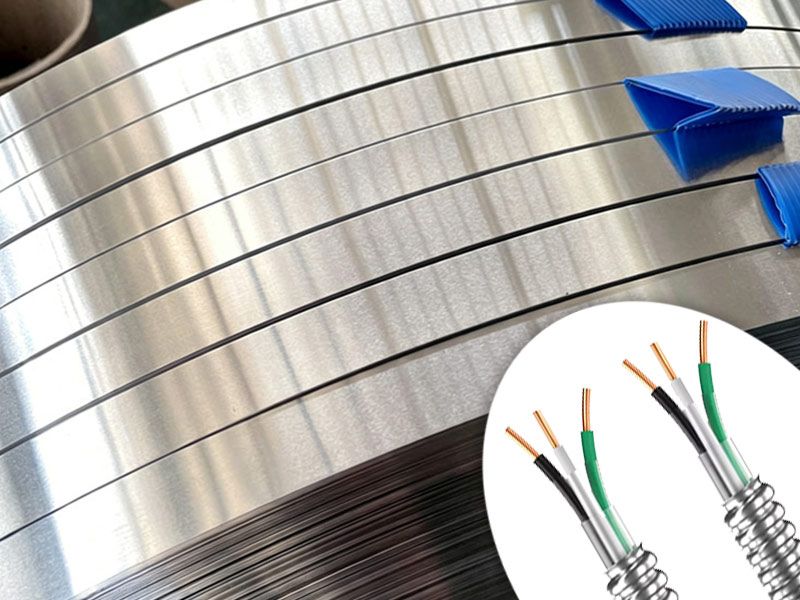
5052, 5154, and 5154A are all Al-Mg series rust-resistant aluminum alloys, suitable for cold-forming processes in cable armoring. Their core differences stem from the magnesium content and trace alloy ratios, which directly affect the material's mechanical properties and processing characteristics:
- 5052 Aluminum Alloy:
Magnesium content 2.2%-2.8%, with 0.15%-0.35% chromium added, typical density 2.68 g/cm³, conforming to ASTM B209 and EN 573-3 standards. The addition of chromium significantly improves pitting corrosion resistance, making it particularly suitable for chloride environments.
- 5154 Aluminum Alloy:
Magnesium content 3.1%-3.9%, no chromium added, density approximately 2.66 g/cm³, belonging to medium-to-high strength rust-resistant aluminum. The higher magnesium content gives the material superior strength while maintaining good weldability and ductility.
- 5154A Aluminum Alloy:
As an improved version of 5154, its magnesium content is controlled at 3.2%-3.8%. Through precise control of trace elements, the processing stability and batch consistency of the material are optimized, making it a customized alloy specifically designed for cable armoring.
The mechanical properties and processing characteristics of the 5052, 5154, 5154A aluminum alloys are crucial to the armoring process. The following are the core indicators under typical conditions:
Performance indicators | 5052 H32 | 5154 H22 | 5154A H22 | Significance of Armor Application |
Tensile strength (MPa) | 230-260 | 175-210 | 180-215 | Determines the tensile and impact resistance of the armor layer |
Elongation (%) | ≥10 | ≥15 | ≥14 | Affecting the flexibility and crack resistance during wrapping molding |
Hardness (HV) | 70-80 | 65-75 | 68-78 | Related armor layer abrasion resistance and scratch resistance |
Bending radius | 1.5× thickness | 1.2× thickness | 1.2× thickness | Determining the feasibility of armoring small-diameter cables |
Core advantages and applications of each aluminum grades for cable armouring
- 5052 Aluminum: A Balanced Choice Between Versatility and Corrosion Resistance
5052 stands out for its excellent corrosion resistance, especially in humid, coastal, and chemical environments. Its moderate strength and good cold-working properties make it suitable for spiral wrapping and interlocking armoring processes, and it is widely used in multi-core power cables, control cables, and underground direct-buried cables. Haomei's 5052 H32 aluminum strip has a thickness tolerance controlled within ±0.01mm and an edge burr ≤0.03mm, ensuring the continuous and stable operation of high-speed armoring production lines.
- 5154 Aluminum: An Optimal Combination of High Strength and Formability
The high magnesium content of 5154 provides greater strength reserves while maintaining excellent elongation, making it particularly suitable for cable applications requiring high mechanical stress. In longitudinal armoring, large-section cables, and installation environments requiring frequent bending, 5154 exhibits superior fatigue resistance compared to 5052. Its chromium-free design meets some environmental standards' restrictions on heavy metal content.
- 5154A Aluminum: A Customized Solution for Armoring
Through compositional fine-tuning and process optimization, 5154A addresses the uneven work hardening issue that may occur with 5154 during high-speed armoring. In the H22 temper, this alloy exhibits a better match between tensile strength and elongation, and is less prone to wrinkling and cracking during wrapping, making it particularly suitable for interlocking armoring of precision communication cables and data transmission cables. Haomei's 5154A products undergo rigorous batch stability control, ensuring material performance deviations of ≤3% across different production cycles, meeting the quality consistency requirements of high-end cable manufacturers.
The selection of cable armoring materials should comprehensively consider the application environment, armoring process, and cost factors:
For corrosive environments, 5052 is preferred: such as coastal areas, chemical industrial parks, and damp underground soil, 5052's resistance to pitting corrosion can extend cable life by more than 50%.
For applications requiring high mechanical strength, 5154 is recommended: such as overhead cables, bridge installations, and cables for frequently moving equipment, 5154's high strength provides more reliable mechanical protection.
For precision armoring and high-speed production lines, 5154A is recommended: especially suitable for communication cables, data cables, and other products requiring high armoring precision, improving production efficiency and reducing scrap rates.
As a professional aluminum strip manufacturer, Haomei Aluminum can provide customized solutions according to customer needs, including aluminum strip for cable armouring with specific alloy grades, precise thicknesses (0.2-1.0mm), widths (20-1250mm), and surface treatments. Our manufacturing process ensures that materials possess uniform mechanical properties, excellent formability, and strict dimensional tolerances, helping cable manufacturers improve product quality and market competitiveness.